

Confusion in the elderly is caused most often by infection, dehydration, medication, dementia, or emotional and environmental factors. Sudden confusion that develops over hours or days, known as delirium, almost always points to a treatable medical cause, while confusion that builds gradually over months or years more often reflects a progressive condition such as dementia. The sections below cover each of these causes in turn, alongside how to recognise warning signs and support someone through an episode of confusion.
What Does Confusion in Older People Mean?
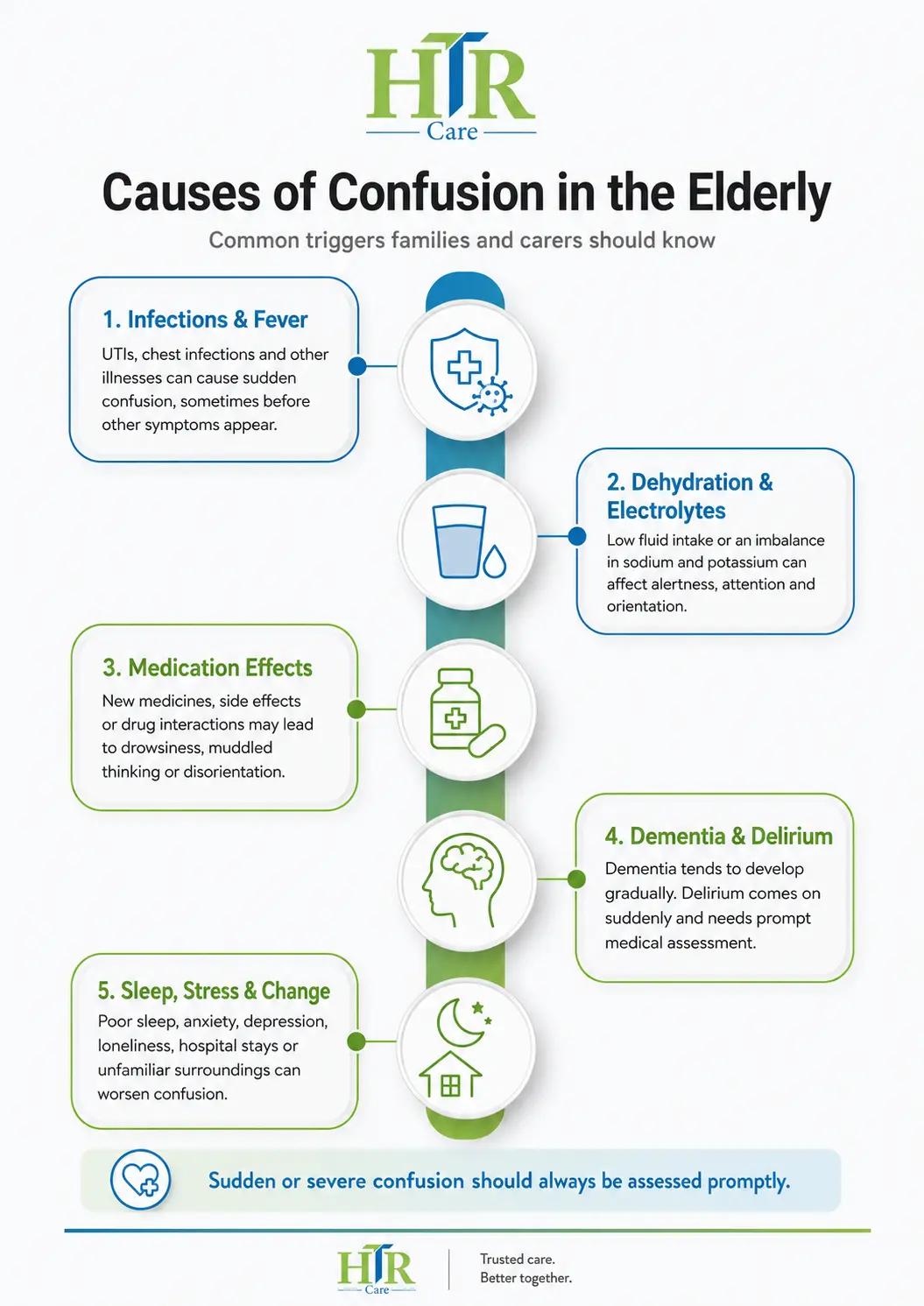
Confusion in older people means a change in someone's ability to think clearly, focus attention, or make sense of their surroundings. It can affect memory, awareness of time and place, and the ability to follow a conversation or complete a familiar task. Confusion is not a normal or inevitable part of growing older; it is a symptom, and like any symptom, it usually points to something happening in the body or mind that needs attention.
What Causes Mild Confusion in the Elderly?
Mild confusion in the elderly is often caused by everyday, treatable factors rather than a serious underlying illness. Tiredness, mild dehydration, a urinary tract infection without other obvious symptoms, or a change in routine can all cause an older person to seem briefly muddled or forgetful. Low-level pain, hunger, or a disrupted night's sleep can have the same effect, particularly in someone who is otherwise frail.
Mild confusion tends to come on gradually and stay limited in scope. The person may lose their train of thought, misplace items more often, or take longer to process what is being said to them, but they generally remain aware of who they are and recognise the people around them. This distinguishes mild confusion from more serious confusional states, where awareness and recognition are also affected.
Why Does an Elderly Person Become Disoriented?
An elderly person becomes disoriented when the brain struggles to process information about time, place, or identity. This can happen because the brain itself is more vulnerable to disruption in later life, even when no long-term cognitive condition is present.
Disorientation in older people is also closely linked to the body's general health. Illness anywhere in the body, including infections, can affect brain function before other symptoms become obvious. This is why a urinary tract infection or chest infection can cause an older person to become disoriented even before a fever develops. Medication changes, pain, and poor sleep can all add to this vulnerability, often layering on top of one another rather than acting alone.
What Is Acute Confusion in the Elderly?
Acute confusion in the elderly, also known as delirium, is a sudden change in attention, awareness, and thinking that develops over hours or a few days. It is different from the slow, gradual decline seen in conditions like dementia, and it is considered a medical emergency that needs prompt assessment.
Acute confusion in older people is almost always linked to an identifiable trigger, such as an infection, dehydration, a new medication, surgery, or a sudden drop in oxygen or blood sugar levels. According to NICE guidance, people aged 65 and over, those with existing cognitive impairment or dementia, those with a current hip fracture, and those with a severe or deteriorating illness are at increased risk of developing this type of confusion. Because the cause is usually treatable, acute confusion often improves once the underlying problem has been identified and addressed, although recovery time varies depending on the person's overall health.
Sudden, Gradual and Intermittent Confusion in Older Adults
Confusion in older adults can develop suddenly, build up gradually, or come and go in episodes, and each pattern points towards a different type of cause. Recognising which pattern you are seeing is one of the most useful things a family member or carer can do, because it shapes how quickly medical advice should be sought and what the doctor will look for first.
Sudden confusion (hours to days) usually signals an acute medical problem, such as an infection or medication reaction, and needs a same-day medical assessment.
Gradual confusion (months to years) usually reflects a slow underlying change in brain function, such as dementia, and is assessed through routine rather than emergency care.
Intermittent or fluctuating confusion, where a person seems clear one hour and muddled the next, is a hallmark of delirium and still needs prompt medical attention even if it resolves on its own between episodes.
What Causes Confusion in Elderly People That Comes and Goes?
Confusion in elderly people that comes and goes is most commonly caused by delirium, which, by definition, has a fluctuating course rather than a constant level of severity. A person with delirium may seem lucid and able to hold a normal conversation in the morning, then become disoriented, withdrawn, or agitated later in the day, often worsening in the evening or at night.
This fluctuation happens because delirium reflects a temporary disruption to brain function rather than permanent damage. As the underlying cause, such as an infection, dehydration, or a medication effect, continues to act on the body, symptoms can intensify; as the body manages or clears the trigger, symptoms can briefly ease. This is also why fluctuating confusion can be easy to miss if a carer only sees the person during their clearer moments.
Sudden Confusion vs Gradual Confusion
Sudden confusion develops over hours or days, while gradual confusion develops over months or years. Speed of onset is the single clearest difference between the two patterns. Onset speed determines the medical response: sudden confusion requires a same-day medical assessment, and gradual confusion suits a planned GP appointment.
Feature | Sudden Confusion | Gradual Confusion |
Onset speed | Hours to days | Months to years |
Typical cause | Infection, dehydration, or a new medication | A progressive condition, such as dementia |
Course | Fluctuates within the same day | Declines steadily over time |
Reversibility | Often reversible once the cause is treated | Not reversible, though symptoms respond to support |
Medical response needed | Same-day assessment | Planned GP appointment or memory assessment |
Delirium vs Dementia Symptoms in Older Adults
Delirium starts suddenly and fluctuates within the same day; dementia develops gradually and follows a steady decline. Attention separates the two conditions most clearly. Delirium disrupts attention and alertness directly, and dementia leaves attention relatively intact in early and moderate stages while affecting memory, language, and planning.
Feature | Delirium | Dementia |
Onset | Suddenly, over hours or days | Gradual, over months or years |
Course | Fluctuates throughout the day | Progresses steadily |
Attention | Significantly impaired | Relatively preserved in early stages |
Main symptoms affected | Awareness, focus, alertness | Memory, language, planning |
Cause | An identifiable trigger, such as an infection or medication | Progressive changes in brain structure |
Reversibility | Often resolves once the trigger is treated | Does not resolve, though care needs respond to support |
What are the Medical Conditions That Cause Confusion in Elderly People?
A wide range of medical conditions can cause confusion in elderly people, and identifying the right one usually requires a doctor's assessment rather than guesswork. The five categories below cover the most common and clinically significant causes seen in older adults.
1. Infections and Fever
Infections are one of the most common causes of confusion in elderly people, and a urinary tract infection (UTI) is among the most frequent culprits. In older adults, confusion can appear as the first and sometimes only sign of an infection, often developing before a fever, pain, or other typical symptoms become obvious.
Respiratory infections, such as pneumonia or chest infections, and more serious infections like sepsis can cause the same effect. This happens because infection triggers widespread inflammation in the body, and the ageing brain is more sensitive to this inflammatory response than a younger brain. Any infection, whatever part of the body it affects, has the potential to cause sudden confusion in an older person.
2. Dehydration and Electrolyte Imbalance
Dehydration and electrolyte imbalance are common, often overlooked causes of confusion in elderly people. Older adults are more prone to dehydration because the sense of thirst naturally reduces with age, and mobility difficulties can make it harder to access fluids regularly throughout the day.
Electrolytes, including sodium and potassium, help regulate the electrical signals that brain cells rely on. When fluid or electrolyte levels fall outside their normal range, brain function can be disrupted, leading to confusion, drowsiness, or disorientation. This can happen alongside dehydration or as a separate issue, for example, as a side effect of certain medications such as diuretics.
3. Low Blood Sugar, Low Oxygen and Blood Pressure Changes
Low blood sugar, low oxygen levels, and sudden blood pressure changes can all cause confusion in elderly people by reducing the amount of fuel or oxygen reaching the brain. The brain depends on a steady supply of both glucose and oxygen, and even a temporary shortfall can affect thinking and alertness.
In people with diabetes, blood sugar that drops too low or rises too high can both cause confusion, alongside symptoms such as shakiness, sweating, or excessive thirst. Low oxygen levels, often linked to chest infections, heart problems, or lung conditions such as COPD, can produce a similar effect, sometimes alongside breathlessness or a bluish tinge to the lips or fingertips. A sudden drop in blood pressure, which becomes more common with age and certain medications, can reduce blood flow to the brain and cause light-headedness and confusion, particularly after standing up.
4. Stroke, Head Injury and Neurological Problems
Stroke, head injury, and other neurological problems are serious causes of confusion in elderly people and require emergency medical attention. A stroke occurs when blood supply to part of the brain is interrupted, and confusion can appear alongside other warning signs, such as facial drooping, slurred speech, or sudden weakness on one side of the body.
A transient ischaemic attack, sometimes called a mini-stroke, can cause similar symptoms that resolve within minutes or hours, but it still signals a significant risk of a future stroke and should always be treated as a medical emergency. Head injuries, including falls that may seem minor at the time, can cause bleeding or swelling inside the skull that leads to confusion sometimes hours or days after the injury itself.
5. Pain, Constipation and Physical Discomfort
Pain, constipation, and other forms of physical discomfort are frequently overlooked causes of confusion in elderly people, particularly in those who are less able to communicate how they are feeling. Untreated pain places stress on the body and can disrupt sleep, both of which increase the risk of confusion, especially in someone who is already frail or living with dementia.
Constipation and urinary retention can have a similar effect. A build-up of waste in the bowel or bladder causes physical discomfort and can trigger a wider stress response in the body, which in some older adults shows up as confusion rather than a clear complaint of pain. This is particularly common in people with dementia, who may be unable to explain what is bothering them.
Does Medication Cause Confusion in Elderly People?
Yes, medication is one of the most common and most reversible causes of confusion in elderly people. Older adults are more sensitive to the effects of many drugs because the body processes and clears medication more slowly with age, which means a dose that was well tolerated for years can start to cause side effects later in life.
Many medicines, particularly those that act on the brain or nervous system, are known to cause confusion in older adults, including some painkillers, sedatives, and treatments for bladder or allergy symptoms.
Confusion can appear shortly after a new medicine is started or a dosage is changed, even for a drug the person has taken safely before.
The more medicines someone takes, the greater the risk, since interactions between different drugs can cause confusion even when each individual medicine is appropriately prescribed.
Medicines That May Cause Confusion in Older People
Several groups of medicines are particularly likely to cause confusion in older people. Anticholinergic medications, which include some antihistamines, treatments for an overactive bladder, and certain antidepressants, work by blocking a brain chemical involved in memory and attention, which can lead to confusion, particularly when several anticholinergic drugs are taken together.
Opioid painkillers and benzodiazepines, often prescribed for pain, anxiety, or sleep problems, can cause sedation and slowed thinking in older adults, even at doses that would have little effect on a younger person. Corticosteroids, used for a range of inflammatory conditions, can cause agitation, mood changes, and confusion, particularly at higher doses. Some medications for Parkinson's disease and certain antibiotics have also been linked to confusion in older patients.
Confusion After a New Medicine or Dosage Change
Confusion after a new medicine or dosage change is common enough that it should always be considered when an older person's thinking changes unexpectedly. Because ageing affects how the body absorbs, processes, and clears medication, even a small increase in dose can have a larger effect than expected.
This type of confusion can begin within hours of the first dose or build up gradually over several days as the medicine accumulates in the body. It is particularly important to watch for new confusion after starting a sedative, a strong painkiller, or any medicine that affects the brain, and after any change made during a hospital stay, since medications are often adjusted around the time of admission or discharge.
Medication Interactions and Polypharmacy
Medication interactions and polypharmacy, meaning the use of multiple medicines at once, significantly raise the risk of confusion in older adults. Each additional medicine increases the chance of an interaction, and some combinations, such as several anticholinergic drugs or an opioid alongside a benzodiazepine, carry a particularly high risk of sedation and confusion when used together.
Polypharmacy becomes more likely as people accumulate prescriptions from different specialists over time, sometimes without a single clinician reviewing the full list together. This is why a regular medication review, ideally including all prescribed and over-the-counter medicines, is one of the most effective ways to reduce medication-related confusion in older adults.
Can Dementia and Alzheimer's Disease Cause Confusion in Elderly People?
Yes, dementia and Alzheimer's disease can cause confusion in elderly people through progressive changes in brain structure and function. Dementia is an umbrella term for conditions that damage brain cells over time, and Alzheimer's disease accounts for the largest share of dementia diagnoses. Confusion in dementia builds gradually, in contrast with the sudden confusion of delirium, and centres on disorientation to time and place, difficulty recognising familiar people, and trouble following conversations. Other forms of dementia, including vascular dementia and Lewy body dementia, produce this confusion through different mechanisms: vascular dementia restricts blood flow to the brain, and Lewy body dementia disrupts the brain chemicals involved in attention.
You May Also Like: Best Games for Dementia Patients
Can Mental Health and Emotional Factors Cause Confusion in Elderly People?
Yes, mental health and emotional factors can cause confusion in elderly people, and depression is the most common psychological cause of dementia-like symptoms in this age group. Anxiety, depression, grief, loneliness, and disrupted sleep affect concentration, memory, and processing speed, producing confusion that closely resembles dementia while standing entirely separate from it.
Three patterns appear most often in older adults: emotional strain that mimics cognitive decline, social loss that erodes mental sharpness over time, and disrupted sleep that brings confusion on after dark. The sections below cover each pattern in turn.
Anxiety, Depression and Stress
Depression causes a recognised pattern of confusion in older adults known as pseudodementia. Pseudodementia involves memory problems, slowed thinking, and difficulty concentrating that closely resemble dementia, and it improves once the underlying depression receives treatment. Severe anxiety produces a similar effect, since persistent worry consumes the mental resources that attention and memory rely on, and chronic stress adds to this burden.
A GP distinguishes pseudodementia from dementia through the pattern of the symptoms, not the symptoms alone. People with pseudodementia tend to notice and worry about their own memory lapses, while people with dementia frequently do not, and this awareness gives a doctor an important early clue.
Grief, Loneliness and Social Isolation
Grief, loneliness, and social isolation increase the risk of confusion in older adults by placing sustained strain on mental function. Bereavement disrupts sleep, appetite, and daily routine, and this disruption reduces mental clarity in the weeks and months following a loss. Regular conversation and social activity exercise the same cognitive functions that confusion affects, and reduced social contact removes this exercise over time, which is why research links chronic loneliness to a measurable increase in the risk of cognitive decline.
Sleep Problems and Night-Time Confusion in Seniors
Sleep problems increase confusion in seniors, and this confusion frequently worsens, specifically in the evening and night, a pattern known as sundowning. Sundowning describes a rise in confusion, agitation, and disorientation that begins in the late afternoon and continues into the night, most commonly in people with dementia, and it stems from disruption in the body's internal clock rather than a separate disease. Low light, accumulated fatigue, and an unfamiliar or recently changed environment all trigger or worsen sundowning, while untreated pain, an unmet need such as hunger or thirst, or an underlying infection can explain a sudden worsening that needs medical assessment rather than environmental changes alone.
Good sleep habits reduce the risk of night-time confusion directly. Regular exposure to daylight, a consistent bedtime routine, and a calm, well-lit evening environment all support the body's natural sleep-wake cycle.
What Does Confusion in Elderly People After Hospitalisation Mean?
Confusion in elderly people after hospitalisation usually means delirium triggered by the hospital stay itself, rather than a new, permanent decline. An unfamiliar environment, disrupted sleep, infection, surgery, and new medications all raise the risk of delirium in older patients, and people aged 65 and over with existing cognitive impairment face the highest risk, according to NICE guidance. This confusion increases distress for the person and their family, but it responds to identifying and treating the specific trigger behind it.
Post-Operative Confusion and Recovery
Post-operative confusion, known as post-operative delirium, develops within hours to a few days after surgery and affects older patients more than younger ones. Anaesthesia, pain, blood loss, and the body's inflammatory response to surgery combine to disrupt brain function temporarily, and risk increases further with longer or more invasive procedures such as hip, heart, or major abdominal surgery. Recovery depends on treating contributing factors directly: adequate pain relief, hydration, early mobility, and a calm, well-orientated environment all support a faster return to the person's usual mental state.
How Long Does Confusion After Hospitalisation Last
Confusion after hospitalisation lasts a few days to one week in most cases, though recovery extends to several weeks or months in frailer patients or those with existing dementia. Symptoms typically ease in step with physical recovery from the underlying illness or operation, and a small proportion of patients experience lingering cognitive changes after the acute episode has resolved. Confusion that has not improved within a week of leaving the hospital warrants a follow-up GP review to rule out an ongoing or new contributing cause.
What are the Warning Signs of Serious Confusion in Elderly People?
The warning signs of serious confusion in elderly people include sudden onset, rapid fluctuation through the day, and accompanying physical symptoms such as fever, weakness, or slurred speech. Confusion that appears alongside facial drooping, sudden severe headache, breathing difficulty, or a recent fall signals a possible medical emergency rather than a routine change, and the combination of symptoms matters more than confusion alone when judging severity.
When to Seek Medical Attention
Seek medical attention immediately if sudden confusion appears alongside stroke symptoms, severe agitation, high fever, or a significant change from the person's usual mental state. A same-day GP appointment suits confusion without these additional warning signs, while symptoms of stroke, a severe head injury, or extreme drowsiness that is hard to rouse require emergency care through 999 or A&E.
What to Do When an Elderly Person Becomes Suddenly Confused
Stay calm, check for obvious causes such as pain or a full bladder, and contact a doctor promptly when an elderly person becomes suddenly confused. Avoid arguing with the person about what is real, since this increases distress without resolving the confusion, and instead offer brief, simple reassurance while noting when the confusion started and what changed beforehand, as this timeline helps a doctor identify the cause quickly.
What are the Treatments for Confusion in Elderly People?
Treatment for confusion in elderly people targets the specific cause behind it, since confusion itself is a symptom rather than a condition to treat directly. A doctor identifies the trigger first, whether infection, medication, dehydration, or an environmental factor, and treatment follows from that diagnosis rather than from the confusion alone. The four areas below cover the core elements of effective treatment and support.
Treating the Underlying Cause
Treating the underlying cause resolves confusion in most cases where an acute trigger, such as infection or dehydration, is responsible. A course of antibiotics clears a urinary tract infection or chest infection, intravenous or oral fluids correct dehydration, and adjusting insulin or other medication corrects unstable blood sugar. Confusion typically improves within days of starting the right treatment, though recovery takes longer in frailer patients or those with existing cognitive impairment.
Reviewing Medication
Reviewing medication identifies and removes drugs that contribute to confusion, often improving symptoms within days of a change. A GP or pharmacist checks the full list of prescribed and over-the-counter medicines for anticholinergic effects, sedation, or harmful interactions, then adjusts the dose or substitutes a lower-risk alternative where appropriate. Medication changes always go through a doctor or pharmacist, since stopping a prescribed drug abruptly carries its own risks.
Supporting Hydration, Nutrition and Sleep
Supporting hydration, nutrition, and sleep reduces the risk of confusion and supports recovery once an underlying cause has been treated. Regular fluids throughout the day prevent the dehydration that commonly contributes to confusion, balanced meals maintain stable blood sugar and energy levels, and a consistent sleep routine reduces the fatigue that worsens disorientation. These measures work alongside medical treatment; they do not replace it when a specific medical cause needs addressing.
Creating a Calm and Familiar Environment
Creating a calm and familiar environment reduces disorientation and supports recovery in someone experiencing confusion. Clear signage, good lighting, a visible clock and calendar, and familiar objects all help a confused person orient themselves to time and place. Reducing background noise, limiting unfamiliar visitors during an acute episode, and maintaining a consistent daily routine further lowers the stress that worsens confusion.
How to Support an Elderly Person Who Is Confused
Supporting an elderly person who is confused means staying calm, communicating simply, addressing physical needs, and seeking medical advice when confusion is new or worsening. Speak in short, clear sentences, identify yourself if recognition seems uncertain, and avoid correcting or arguing with the person about what they believe is happening, since this increases distress without improving clarity. Check for pain, hunger, thirst, or a need for the toilet, as these unmet needs frequently underlie or worsen confusion, and maintain familiar routines and surroundings wherever possible to reduce disorientation.
Day-to-day support becomes harder to sustain alone once confusion is frequent, fluctuating, or linked to an ongoing condition such as dementia. A live-in carer provides consistent, round-the-clock support in the person's own home, helping to maintain routine, monitor changes in behaviour, and respond quickly if confusion worsens, while giving family members the reassurance that their loved one is never without support. For families exploring this option, live-in care in London from HTR Care provides a consistent, familiar carer matched to the individual's routine and needs, with support that can begin within 24 to 48 hours of the first enquiry.

About Meena Pradhan
Care Coordinator/Senior Field Supervisor